Right, let’s talk about nymph fishing. If you’ve been happily casting dry flies and wondering why your mate consistently catches more fish, chances are they’ve been fishing below the surface while you’ve been waiting for rises that never came. The truth is, trout spend about 90% of their time feeding underwater, and if you’re not fishing nymphs, you’re missing out on the majority of the action on our British rivers.
Nymph fishing doesn’t need to be complicated. At its heart, it’s about getting an imitation of a subsurface insect down to where the fish are feeding and detecting when they eat it. That second bit is where most beginners struggle, but we’ll get to that.
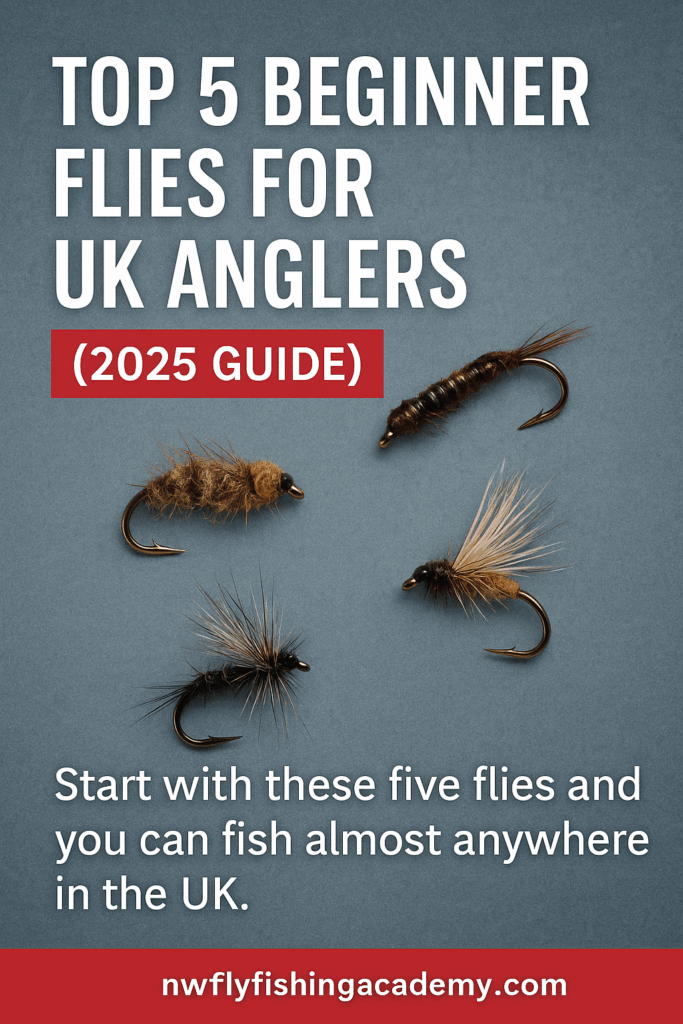
Let’s start with the basics. You’ll want a few weighted nymphs in sizes 12 to 16. Hare’s ear nymphs, pheasant tail nymphs, and copper johns are perfect starting points. These patterns imitate the caddis larvae, mayfly nymphs, and general creepy crawlies that make up the bulk of a trout’s diet in streams like the Test, Usk, or your local chalk stream.
The simplest method to start with is the dead drift technique. Cast upstream at about a 45-degree angle and let your nymph drift back towards you naturally with the current. The key word here is naturally. Your nymph should be tumbling along like a real insect would, not dragging across the current in an obviously artificial way. To achieve this, you need to mend your line. As your nymph drifts, the current will catch your fly line and create a bow that pulls your nymph unnaturally fast. Flip your line upstream in a gentle rolling motion to reduce this drag.
Now, here’s where it gets interesting. Detecting takes when nymph fishing requires proper concentration. You can’t see your fly, so you need to watch your leader or use a strike indicator. I’d recommend starting with a simple indicator. A small tuft of yarn or a purpose-built strike indicator attached to your leader about twice the depth of the water you’re fishing will help you spot takes. When it pauses, dips, or does anything unusual, lift your rod. Don’t strike hard like you’re setting a hook in a pike. A gentle lift of the rod tip is enough with trout.
The French leader technique has become popular on UK rivers recently, and for good reason. It’s more sensitive than using a bulky indicator and lets you feel takes directly. You can pick up a specialized French leader setup or make your own with coloured sections of monofilament. Watch where your leader enters the water. Any hesitation or unusual movement means lift that rod.
Water depth matters more than most beginners realize. Your nymph needs to be bouncing along near the riverbed where trout are looking for food. If you’re not occasionally touching bottom, you’re probably fishing too shallow. Add a small split shot about 30cm above your nymph if needed.
Location is half the battle. Look for deeper runs, the seams where fast water meets slow water, and anywhere the current breaks around rocks or structure. These are natural feeding lanes where trout sit and wait for food to come to them. The heads and tails of pools are particularly productive spots that many anglers walk right past.
Practice makes perfect with nymph fishing. Your first few sessions might feel frustrating compared to the visual excitement of dry fly fishing, but stick with it. Once you start connecting with fish consistently, you’ll understand why so many experienced anglers spend most of their time fishing below the surface.
Here’s something practical for your next trip. Tie on two nymphs instead of one. Use a heavier pattern as your point fly and a lighter, smaller nymph on a dropper about 40cm up the leader. This lets you cover two depths at once and often the trout will show a preference for one size over the other. You’ll figure out the pattern faster and catch more fish while you’re learning.