When to fish them, how to fish them, and why they work
The Fish Are Rising. Your Fly Isn’t Working. Here’s Why.
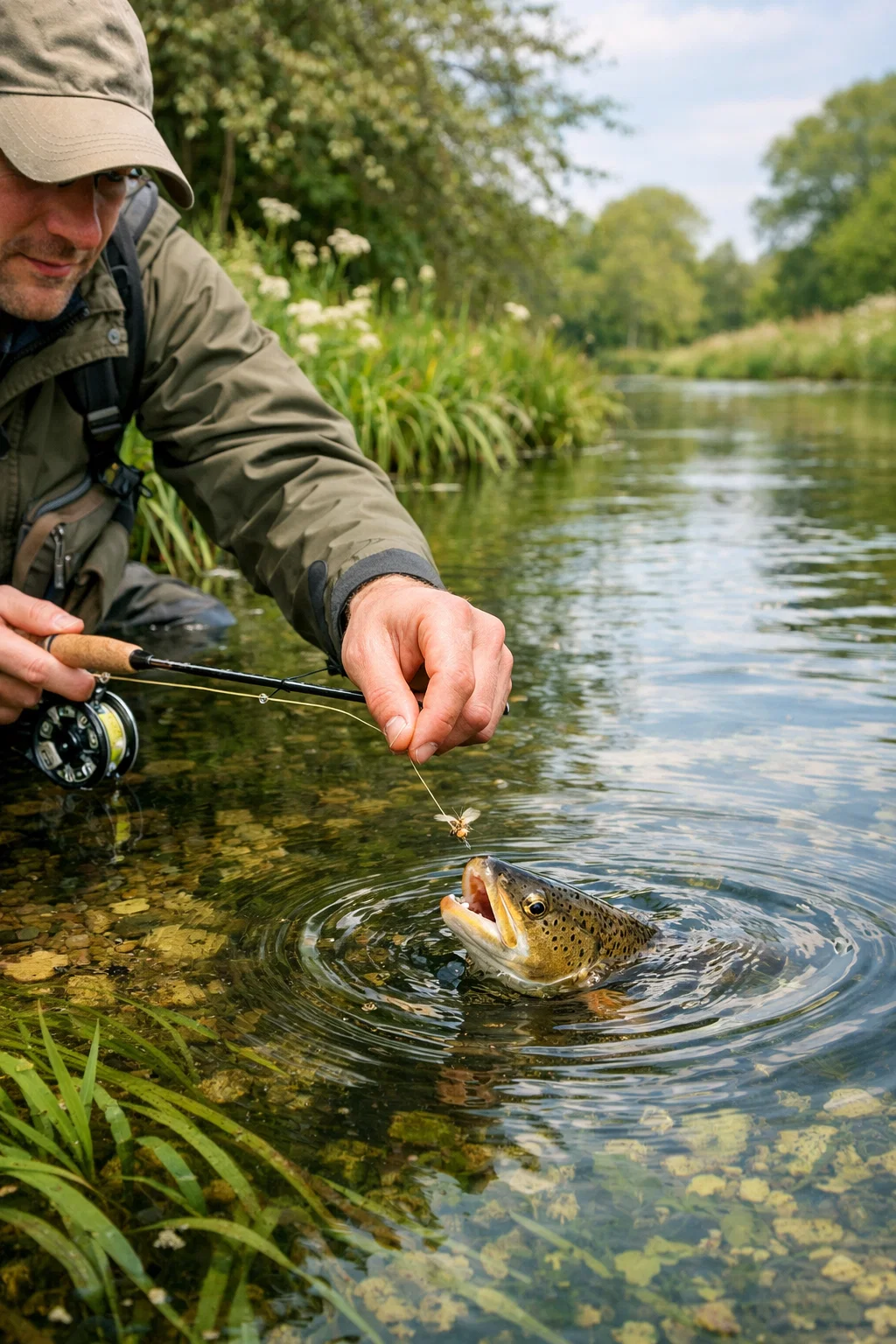
You can see the rises. You’ve tied on a dry fly. You’ve cast over those fish a dozen times.
Nothing.
This is the most frustrating moment in spring fly fishing, and it happens to almost every angler until they understand one simple thing: the pattern, size, and presentation of a dry fly matters far more in spring than any other time of year.
Spring trout are selective. They’re keying onto specific insects. A fly that’s wrong in size by two hook sizes, or wrong in profile, gets refused every time. This guide tells you exactly which dry flies work on UK rivers from March through June, and more importantly, when and how to use each one.
Affiliate Disclosure: This article contains Amazon affiliate links. As an Amazon Associate I earn from qualifying purchases at no extra cost to you.
| My Top Pick for Spring Dry Fly Fishing
A Parachute Adams in size 14 and 16 is the single most versatile spring dry fly for UK rivers. It imitates almost nothing specifically and almost everything generally. Start there before anything else. Assorted Ready-Made Flies Kit with Magnetic Fly Box: https://amzn.to/4rJpgdD Waterproof Fly Box (keep them organised): https://amzn.to/4ta9w4N |
What Makes Dry Fly Fishing Different in Spring
Most of the year you can get away with a rough imitation. Fish that are actively searching for food will take a fly that looks broadly edible. Spring is different.
From March through May, trout on UK rivers are feeding during hatches. They find a specific insect emerging in numbers, position themselves in the current to intercept it, and become locked onto that food source. Show them something that looks wrong and they ignore it. Show them something that looks right, presented without drag, and they take it with confidence.
That selectivity is what makes spring dry fly fishing challenging. It’s also what makes it so rewarding when you get it right.
| The drag question: before you change your fly, ask yourself whether your fly is dragging across the current.
A perfect imitation presented with drag will be refused every time. An average imitation presented drag-free will be taken. Fix the presentation before changing the pattern. |
The 7 Best Spring Dry Flies for UK Trout
1. Parachute Adams — The Universal Spring Dry
Here’s the thing about the Parachute Adams: it shouldn’t work as well as it does. It doesn’t imitate any specific UK insect. It’s an American pattern. And yet it consistently outfishes more ‘accurate’ imitations on rivers from the Test to the Tay.
The reason is silhouette. Trout look up at flies from below. They see a shape against the sky, not colour or pattern detail. The Parachute Adams has exactly the right shape for most UK spring flies, and the white parachute post makes it visible from ten metres on rippled water.
When you’re not sure what’s hatching, tie on a Parachute Adams. It’s not the best fly for any specific hatch, but it’s rarely wrong.
- Hook size: 14-16 as priority, carry 12 and 18 as backup
- Conditions: Any — overcast days, mixed hatches, uncertain situations
- Works on: Every UK trout river, chalk streams, reservoirs, Scottish lochs
- Tip: The orange post version is easier to track on broken water
| Pros | Cons |
|---|---|
|
|
Who this is for: every spring angler, especially those new to dry fly fishing.
Who should consider alternatives: experienced chalk stream anglers targeting very selective fish during a specific hatch.
2. Elk Hair Caddis — Spring’s Most Reliable All-Day Fly
Caddisflies hatch on virtually every UK river throughout spring. They’re not always the dominant insect, but they’re almost always present. The Elk Hair Caddis is the best all-round imitation there is.
What makes it particularly useful is that it works two ways. Fish it dead drift for selective trout that are rising steadily. Or skitter it — pull it across the surface in short bursts — to imitate a caddis trying to take off. That skating movement produces savage takes from fish that have ignored a static fly.
Carry it in tan, olive, and brown. The colour matters less than most people think, but having options doesn’t hurt.
- Hook size: 12-16
- Best colours: Tan, olive, brown — match the natural if possible
- Technique: Dead drift or skittered across the surface
- Season: April through October — genuinely year-round
3. F-Fly (CDC Emerger) — The Pattern That Catches Picky Fish
This is the fly that separates anglers who’ve done their homework from those who haven’t. The F-Fly sits in the surface film rather than on top of it, imitating an insect halfway through emerging from its nymphal case. It looks helpless. Trout find it irresistible.
The problem is that it’s almost impossible to see on the water. Most beginners never fish it properly because they can’t track it. The solution is to fish it on a short dropper below a visible dry fly like a Parachute Adams. The Adams acts as a strike indicator. When it moves — lift.
During any olive hatch when fish are sipping quietly at the surface, switch to an F-Fly before you change pattern entirely. The fish are often taking emergers, not adults.
- Hook size: 14-18
- Material: CDC feathers — natural oils keep it floating without false casting
- Best during: Olive hatches, midge hatches, any quiet sipping rise
- Tip: Fish it 30-40cm below a visible dry on a fine tippet dropper
| If fish are rising confidently but refusing your conventional dries, the answer is almost always an emerger pattern.
They’re taking the insect just as it breaks through the surface film, not after it’s sitting on top. The F-Fly fished in the film is the most effective solution for this situation on UK rivers. |
4. Klinkhammer — The Rough Water Specialist
The Klinkhammer is a Dutch pattern that arrived on UK rivers twenty years ago and never left. Its genius is the bent hook and parachute hackle that suspend the body in the surface film while keeping the fly visible from above.
On fast broken water — the kind that destroys conventional dry flies in a few drifts — the Klinkhammer holds its position perfectly. Northern freestone rivers, Welsh spate rivers, rocky Scottish streams. This is the fly for all of those.
It also works for grayling into May, which extends its usefulness considerably beyond trout-only fishing.
- Hook size: 12-16 on a curved emerger hook
- Best on: Fast broken water, northern rivers, Welsh spate rivers
- Body colours: Olive, orange, pink (the pink version is exceptional for grayling)
- Presentation: Dead drift in the faster seams and runs
5. Blue Winged Olive — The Evening Rise Fly
From May onwards, the most reliable dry fly session of the day is the last one. As the light drops, Blue Winged Olives hatch and trout come to the surface in the tail of pools to feed on them. This evening rise can last 45 minutes of genuinely consistent action.
Fish that have been frustratingly difficult all day suddenly become predictable and catchable. They’re rising in the same spots, in a rhythm you can read, and a size 14-16 BWO dry presented a foot upstream of the last rise will be taken confidently.
Stay on the river late in May. Bring a head torch. The evening rise is worth it every time.
- Hook size: 14-16
- When: May to July, evenings from around 7pm
- Where: Tail of pools, flat glides, chalk streams and limestone rivers
- Presentation: Fine tippet, delicate dead drift, position downstream of rising fish
6. Hawthorn Fly — Two Weeks That Change Everything
The Hawthorn fly is a terrestrial. It blows in from hedgerows in May, timed with the hawthorn blossom, and triggers some of the most confident surface feeding of the spring season.
The key is the long trailing legs. Without them, your imitation won’t work. A size 10 Hawthorn with proper knotted legs will bring trout from several feet away when they’d ignore everything else. Watch the hawthorn blossom in your area. When it’s out, be on the river.
- Hook size: 10-12
- Critical feature: Long knotted legs trailing below the hook
- When: Two to three weeks in May — timing varies by location
- Where: Rivers with bankside hedgerows, hawthorn bushes, trees
7. Comparadun — The Chalk Stream Closer
Chalk stream trout in Hampshire and Wiltshire are the most educated fish in the UK. They see more anglers, more flies, and more presentations than any other river fish. Standard bushy dry flies get refused.
The Comparadun — a low-riding American pattern with a spun deer hair wing — works because it sits flat in the surface film with exactly the right silhouette. It doesn’t look like a fly. It looks like a fly. There’s a difference, and pressured chalk stream trout know it.
Carry these in olive, sizes 16 and 18, if you fish the Test, Itchen, Kennet, or Avon.
- Hook size: 14-18
- Wing: Spun deer hair — flat, low-riding profile
- Best on: Chalk streams, pressured limestone rivers
- When: Any time trout are being selective during an olive hatch
Quick Comparison — Which Dry Fly to Use
| Situation | Best Choice |
|---|---|
| Not sure what’s hatching | Parachute Adams size 14 — versatile, always a safe start |
| Fish sipping quietly, refusing dries | F-Fly or CDC Emerger size 16 — they’re on emergers |
| Fast broken northern river | Elk Hair Caddis or Klinkhammer — buoyant and visible |
| Evening rise in May or June | Blue Winged Olive size 14-16 — classic choice |
| Chalk stream, very selective fish | Comparadun size 16-18 — low profile wins here |
| Windy May day, large flies on water | Hawthorn Fly size 10-12 — match the terrestrial |
| Fish still refusing after pattern changes | Go one size smaller, then try a CDC emerger on a dropper |
Three Technique Points That Matter More Than Pattern Choice
1. Fine tippet is not optional
Spring rivers are often clear and low. Tippet visibility is a real problem. If you’re fishing 4lb or 5lb from winter nymphing and wondering why fish are refusing your dry, the tippet is the first thing to change.
Use 3lb for most dry fly work in April. Drop to 2lb or 2.5lb on clear chalk streams and pressured water. Yes, you’ll lose a fish occasionally. The extra takes more than compensate.
2. Approach from downstream, always
Trout face upstream into the current. Approaching from downstream means you’re behind their field of vision. Your fly arrives before you do. On clear spring rivers where fish are easily spooked, this basic discipline makes an enormous difference to how many fish you get a cast over.
3. Wait longer between casts than feels comfortable
The instinct when a fish refuses is to cast again immediately. The right move is to wait. A trout that’s been put down by a refused fly will resume rising within two or three minutes if you haven’t spooked it further. Patience catches more fish than persistence.
Who This Guide Is For
| This is for you if… | Less relevant if… |
|---|---|
| You want to move from nymphing to surface fishing | You fish mainly stillwaters — different techniques apply |
| You’re fishing UK rivers from April to June | You’re targeting grayling — nymphing remains more effective |
| You want to understand why fish refuse dry flies | You already have a strong dry fly background |
Final Decision — What to Actually Buy
If you’re building a spring dry fly box from scratch, start with three patterns: Parachute Adams, Elk Hair Caddis, and CDC Emerger. Those three cover the majority of UK spring situations.
Add a BWO for evening fishing in May. Add a Hawthorn for the blossom window. If you fish chalk streams, add Comparaduns in size 16 and 18.
Store everything in a waterproof fly box. Wet flies fish badly and deteriorate quickly.
| Spring dry fly kit:
Assorted Ready-Made Flies Kit with Magnetic Fly Box: https://amzn.to/4bJRG18 Waterproof Fly Box: https://amzn.to/3NlH3tx Polarised Sunglasses (essential for spotting rises): https://amzn.to/4s9MGJH |
Go Fishing
Dry fly fishing in spring is one of the most satisfying things you can do with a fly rod. The skill gap between anglers who understand it and those who don’t is real, but it’s entirely learnable.
Start with a Parachute Adams. Watch the water before you cast. Use finer tippet than feels comfortable. Stay on the river late in May.
The rest will come with time on the water.
- Best Spring Flies UK (all patterns guide): https://nwflyfishingacademy.com/best-spring-flies-uk-trout-grayling/
- Spring Fly Fishing Tips UK: https://nwflyfishingacademy.com/spring-fly-fishing-tips-uk/
- Best Fly Fishing Rods UK: https://nwflyfishingacademy.com/best-winter-fly-fishing-rods-uk/
- How to Read a River UK: https://nwflyfishingacademy.com/%f0%9f%8c%8a-how-to-read-a-river-like-a-pro-finding-trout-and-grayling-in-any-flow/