You spend all this time perfecting your cast, tying flies at the vice until your eyes blur, reading about hatches and water temperatures. But how often do you actually think about what’s happening below the surface from the fish’s perspective?
Gear Used in This Article
I’ll be honest, I spent years fishing the Eden near Appleby without really considering this properly. Just whacking flies at rising trout and getting frustrated when they refused perfectly good presentations. Then one summer I got a GoPro on the cheap and started mucking about with it, strapping it to rocks in the shallows, watching the footage back. Absolute revelation. The way trout behave underwater bears almost no relation to what I’d imagined from the bank.
First thing that struck me was the movement. Trout aren’t just hanging there waiting for your fly. They’re constantly adjusting position, sometimes by millimetres, sometimes darting forward or dropping back. They’re reading the current in ways we can’t see from above, finding those sweet spots where the flow brings food to them without exhausting them. Watch a feeding fish for any length of time and you’ll see it’s doing this perpetual dance, holding station but never truly still.
The other thing is their field of vision. We all know about the cone of vision breaking through the surface, that window they can see through. But what gets forgotten is how much of their world is underwater. They’re scanning constantly, not just looking up. A nymph drifting past at mid-depth, a shrimp kicking off the bottom, another trout muscling into their space. They’re processing all of this simultaneously while we’re stood there wondering why they won’t eat our Klinkhamer.
Here’s something that changed how I fish. Trout inspect stuff way more than you think. That split second you see a fish rise and refuse your dry? Underwater that’s a much longer interaction. They’ve drifted back, come up, had a proper look, decided something’s not right, rejected it. Could be the drag you didn’t spot. Could be your tippet catching the light. Could be the proportions of your fly are just slightly off compared to the naturals. They’ve got time to be picky because in their world, that fly is moving in slow motion relative to their reaction speed.
The takes themselves are fascinating when you see them properly. Sometimes aggressive, sure, but often remarkably gentle. A grayling sipping a nymph barely moves. Just opens its mouth, the current does the rest. No wonder we miss so many takes. We’re waiting for a proper thump but they’re just inhaling and exhaling, sorting food from rubbish in their mouth. By the time you’ve noticed, the fly’s already been rejected.
Depth perception from the bank is absolutely terrible too. That fish you think is right on the bottom? Probably eighteen inches up. That one you reckon is just subsurface? Could be two feet down. The refraction plays havoc with your judgment. This is why a good pair of polarised glasses makes such a difference to actually understanding what you’re looking at. I never head out without a decent pair of polarised glasses these days.
Worth checking out: polarised glasses
Spooking fish is another aspect that makes more sense once you’ve seen it from their angle. The shadow of your rod, your profile on the skyline, vibrations through the bank. Underwater, a spooked trout doesn’t always bolt. Sometimes it just stops feeding and drops deeper, still visible but no longer interested. You’re stood there casting to a fish that’s basically shut down, wondering why your fly change isn’t working. It’s not the fly. You’ve already lost before you started.
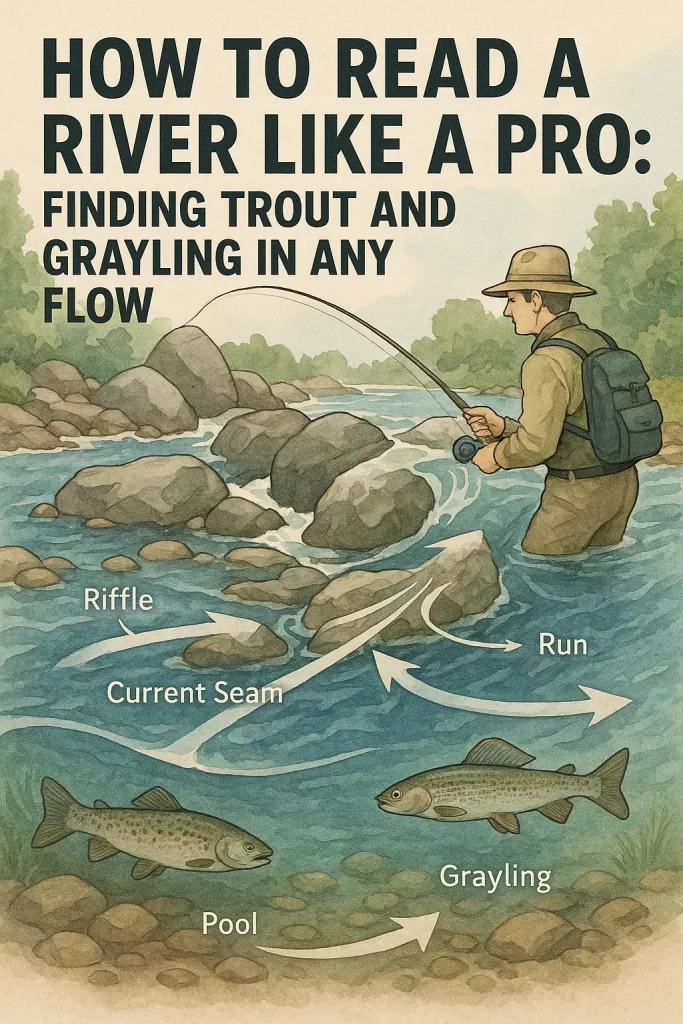
Current seams and lies make more sense too when you visualise the underwater landscape properly. That bit of river that looks featureless from above? Below the surface there’s a boulder creating a cushion of slack water, or a depression in the gravel where the flow eases off. Trout stack up in these spots because it’s efficient. Why fight the current when you can let physics do the work?
I’ve started mentally mapping the riverbed as I wade now. Feeling with my feet, noting where the depth changes, where the flow pushes harder. Building a picture of what the fish are experiencing. It’s made me fish slower, more deliberately. Less random casting, more thinking about where a fish would actually be and why.
Temperature gradients matter more than most anglers realise too. Cold water sinks, warmer water rises, and fish position themselves accordingly. On a hot summer day, trout might be right on the bottom in the deepest runs, or tucked under overhanging trees where it’s shaded. In spring when the water’s warming, they might be up in the shallows where the sun’s hitting. They’re constantly making these calculations, seeking comfort and food simultaneously.
The social dynamics are another layer entirely. Hierarchies exist in every pool. Bigger fish get prime lies, smaller ones get pushed to marginal water. Sometimes you’ll see a decent trout just evict a smaller one from a feeding lane, no ceremony about it. This is why that one perfect spot sometimes produces and sometimes doesn’t. The fish that should be there has been muscled out by something bigger you haven’t spotted yet.
Predation awareness is always running in the background too. Herons, cormorants, pike, otters. They’re wary in a way that’s hard for us to appreciate. Any sudden movement, any unusual shadow, and that survival instinct kicks in. Overrides feeding. Overrides everything. You’ve got to earn their trust by being part of the scenery, not an intruder.
Related Reading:
Next time you’re on the water, spend ten minutes just watching before you cast. Find a feeding fish and observe properly. Try to imagine what it’s seeing, what it’s feeling through its lateral line, how it’s reading the drift. Your presentation will improve because you’ll be thinking like a fish rather than just throwing techniques at the problem.