You know what the worst part about making a proper cock-up on the river is? It’s not the lost fish or the snapped tippet. It’s that moment when you realise you’ve been doing something fundamentally wrong for months, maybe years, and nobody bothered to tell you. Or worse, you just never noticed because you were too busy convincing yourself you knew what you were doing.
Gear Used in This Article
The mistake I’m talking about isn’t some subtle technical thing that only matters when you’re after spooky brown trout on a gin-clear chalk stream. This is bigger. More fundamental. And chances are, if you’re honest with yourself, you’ve probably done it too.
I spent far too long fishing like I was trying to prove something. Not to other anglers exactly, but to myself. Every session had to be about catching more fish than last time, or bigger fish, or using more technical methods. I’d rock up to a stretch of river I knew inside out and immediately start thinking about what complicated rig I should tie on, which obscure pattern might give me an edge, whether I should be fishing a French leader setup or working on my double haul. All the while completely ignoring what the river was actually telling me.
Anyone who’s fished UK rivers for a few seasons knows that feeling when you see another angler absolutely cleaning up while you’re struggling. They’re twenty yards downstream, using what looks like the simplest possible setup, and fish after fish comes to the net. Meanwhile you’re festooned with gear like a walking tackle shop, changing flies every ten minutes, and getting nowhere. That used to be me on both sides of the equation, but I spent far too long being the one with all the gear and no idea.
The thing is, we get sold this idea that progression in fly fishing means constantly adding complexity. Better casting techniques, more refined presentations, a deeper understanding of entomology. And sure, all that stuff matters. But somewhere along the way, I’d forgotten that the best anglers I know are the ones who’ve stripped things back to what actually works. They’re not simpler because they don’t know any better. They’re simpler because they’ve learned what matters and what’s just noise.
Picture standing on a riverbank on a breezy April afternoon. There’s a decent hatch coming off, you can see rises here and there, and conditions are pretty much perfect. You’ve got a box with about forty different dry fly patterns, half of them tied in three different sizes. What do you do? If you’re anything like I used to be, you spend fifteen minutes agonising over the choice, switch flies twice before you’ve even made a cast, and then spend the whole session second-guessing yourself. All that mental energy wasted on stuff that probably makes about five percent difference to your results.
The fish don’t care about your casting qualification or whether you’ve read every Skues and Halford book ever written. They care about whether what you’re showing them looks like food, behaves like food, and appears at the right depth in the right place without a bloody great thick leader attached to it scaring them witless. That’s it. Everything else is just us getting in our own way.
Now I’m not saying technique doesn’t matter or that you should stop learning. But there’s a difference between developing skills that help you catch fish and accumulating knowledge for its own sake. I spent years in the second camp, treating fly fishing like it was an academic subject where marks were awarded for difficulty. Turns out the river doesn’t give bonus points for making things harder than they need to be.
The shift happened gradually rather than all at once. You start having sessions where you deliberately limit yourself. One rod, one box, three patterns. You fish a single dry fly all afternoon just to see what happens. And slowly it dawns on you that you’re catching just as many fish, probably more, and you’re actually enjoying it rather than treating it like some kind of exam you’re trying to pass.
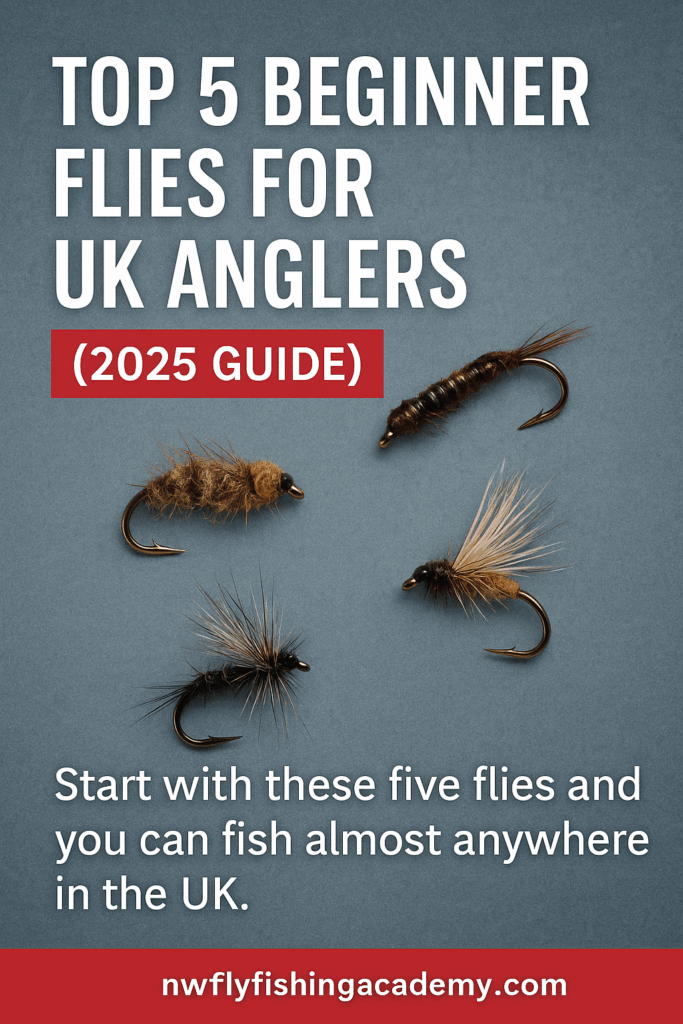
Beginners often find this easier than intermediate anglers because they haven’t had time to overcomplicate things yet. They fish a Pheasant Tail Nymph because someone told them it works, and guess what, it does. They’re not paralysed by choice or worried about whether they should be using something more sophisticated. There’s a lesson in that.
These days I spend far less time fiddling with gear and far more time watching the water. I carry less stuff. I change flies less often. When something’s working, I stick with it instead of trying to optimise an extra five percent that probably doesn’t exist anyway. And the fishing is better for it, not because my technique has improved but because I’m actually paying attention to what matters.
If you struggle with seeing what’s happening below the surface, especially in that murky water we get after a bit of rain, decent polarised glasses make a massive difference to spotting fish and reading the river properly.
So here’s what I’d suggest. Next time you head out, deliberately limit yourself. Take one fly box, maybe two rods maximum. Pick patterns you’re confident with rather than stuff you think you should be using. Spend the first fifteen minutes just watching before you make a cast. See how much of your usual routine is actually helping you catch fish and how much is just ritual and anxiety disguised as preparation.
The biggest mistake wasn’t any single technical thing I got wrong. It was believing that more knowledge, more gear, more complexity would somehow make me a better angler. The river doesn’t work like that. Fish it with less ego and more attention, and you’ll catch more than you ever did while trying to prove how much you know.