
Free catch-and-release tool
Trout Weight From Length Calculator
Estimate the weight of a brown trout, rainbow trout or sea trout from a measurement, without lifting it out of the water for scales. Enter length alone for a broad range, or add girth to tailor the estimate to that fish. It is an estimate, not a weighed result.
Your estimate will appear here
Ready when you are
Enter the measurements and select Estimate trout weight.
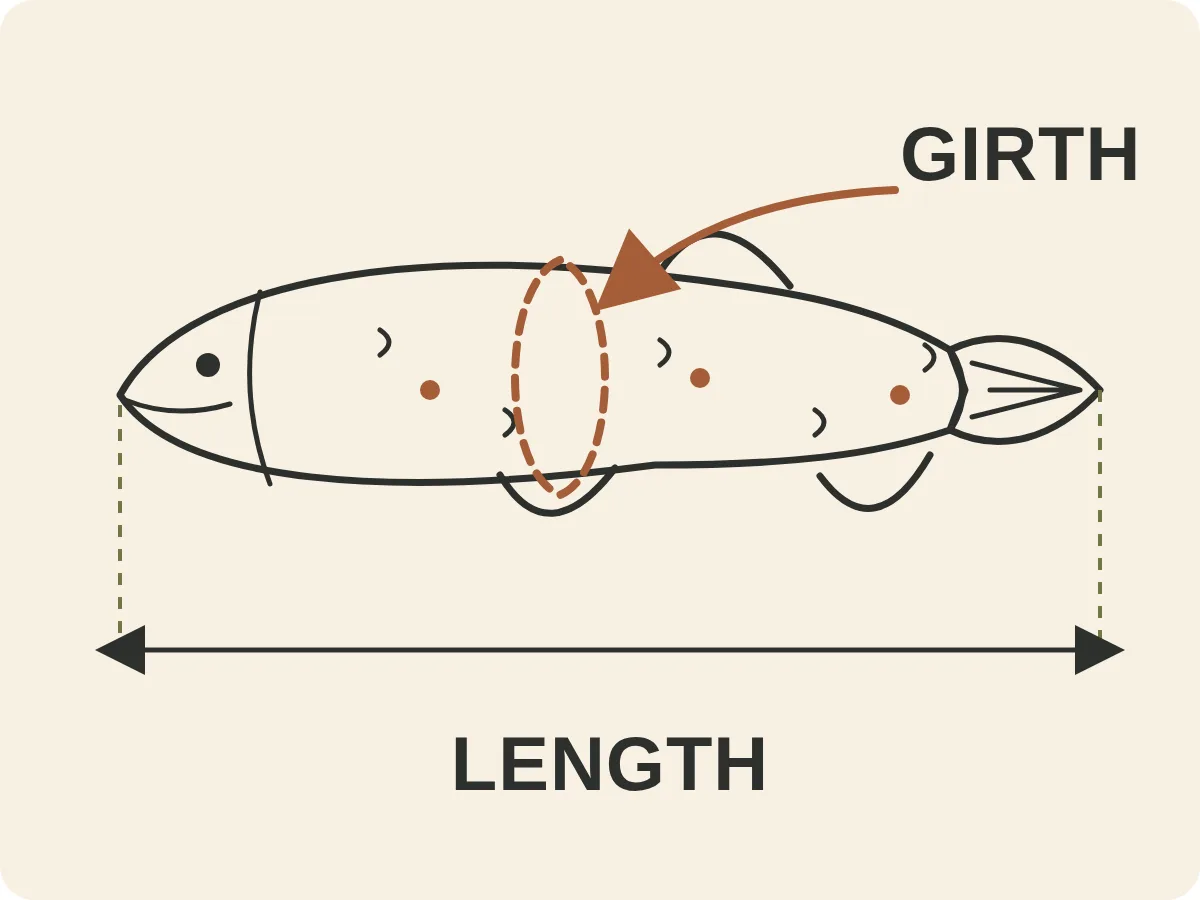
How the trout weight estimate works
Length alone cannot reveal an exact weight because two trout of the same length can have different body depth and condition. The calculator therefore reports a range rather than a single exact-looking figure.
For a length-only estimate, the calculator uses a standard condition-factor relationship, weight in grams = K × length in centimetres³ ÷ 100. K is a plumpness figure: the calculator uses 0.9 for a slim trout, 1.05 for an average one and 1.2 for a deep-bodied one, so you can see the assumption. The range shown is about 15% either side of the estimate. That is a simple allowance, not a measured error.
If you add girth, the calculator uses the familiar field estimate weight in pounds = length in inches × girth² ÷ 800. The range is about 10% either side, and it is again a simple allowance rather than a tested accuracy figure. When girth is entered, the body condition setting is not used.
The trout type does not change either calculation. Brown, rainbow and sea trout all use the same formulas, so the choice does not make the estimate species-specific. Treat sea trout figures with extra caution, because their shape varies with run stage and time in freshwater.
When this calculator is most useful
Catch and release
Note a reasonable estimate without hanging a trout from scales or prolonging handling.
Personal catch records
Use one consistent method across your log and label the figure as an estimate.
Club and fishery reports
Give the measured length alongside the estimated range, so readers can see what was measured and what was calculated.
Frequently asked questions
How accurate is trout weight from length?
It is an estimate, and this page has not been checked against weighed fish. Adding girth usually tailors the figure to the individual trout, but body condition, spawning state and how the measurements were taken can all change the result.
Should I measure girth on every trout?
No. Length alone is enough for a quick estimate. If measuring girth would keep the fish out of the water longer, leave it blank.
Does the calculator work for sea trout?
It will give a figure, but it uses the same formulas as for brown and rainbow trout, and sea trout vary substantially in condition. Treat the range as a rough field estimate and record the measured length alongside it.
Why is the result a range?
Natural fish of equal length do not all weigh the same, so a single exact-looking number would suggest more certainty than the measurements can support.
