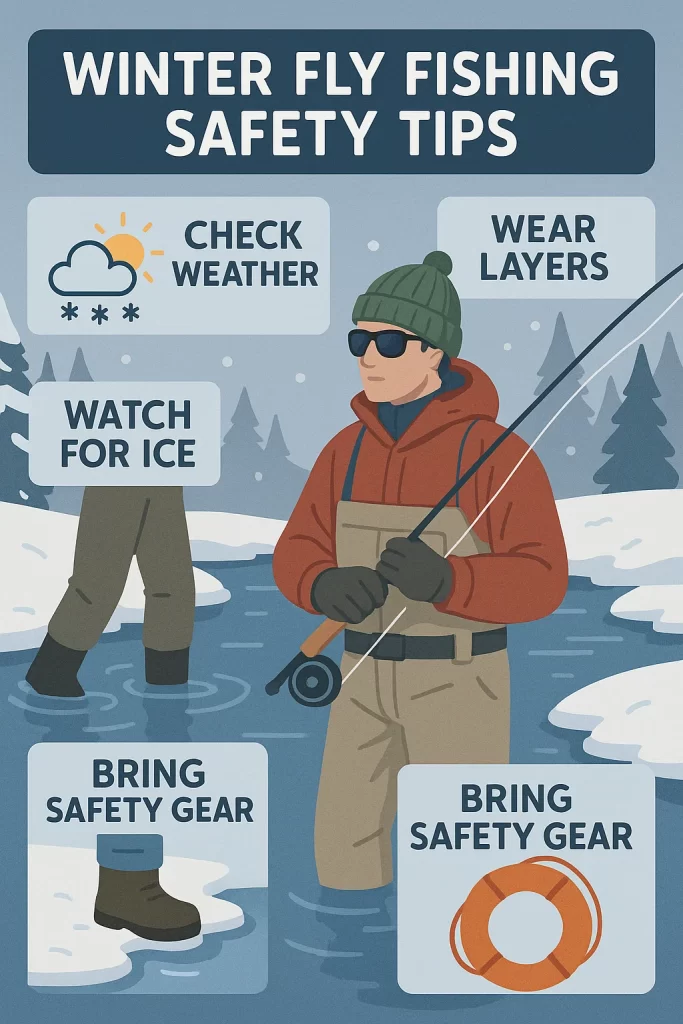
Winter fly fishing can provide quiet rivers and worthwhile trout or grayling fishing, but colder water, shorter daylight and changing river levels call for a more considered approach. The aim is not to follow rigid rules; it is to adjust safely to the water in front of you.
These ten practical tips cover preparation, clothing, depth, drift, fly choice and watercraft for UK winter conditions.
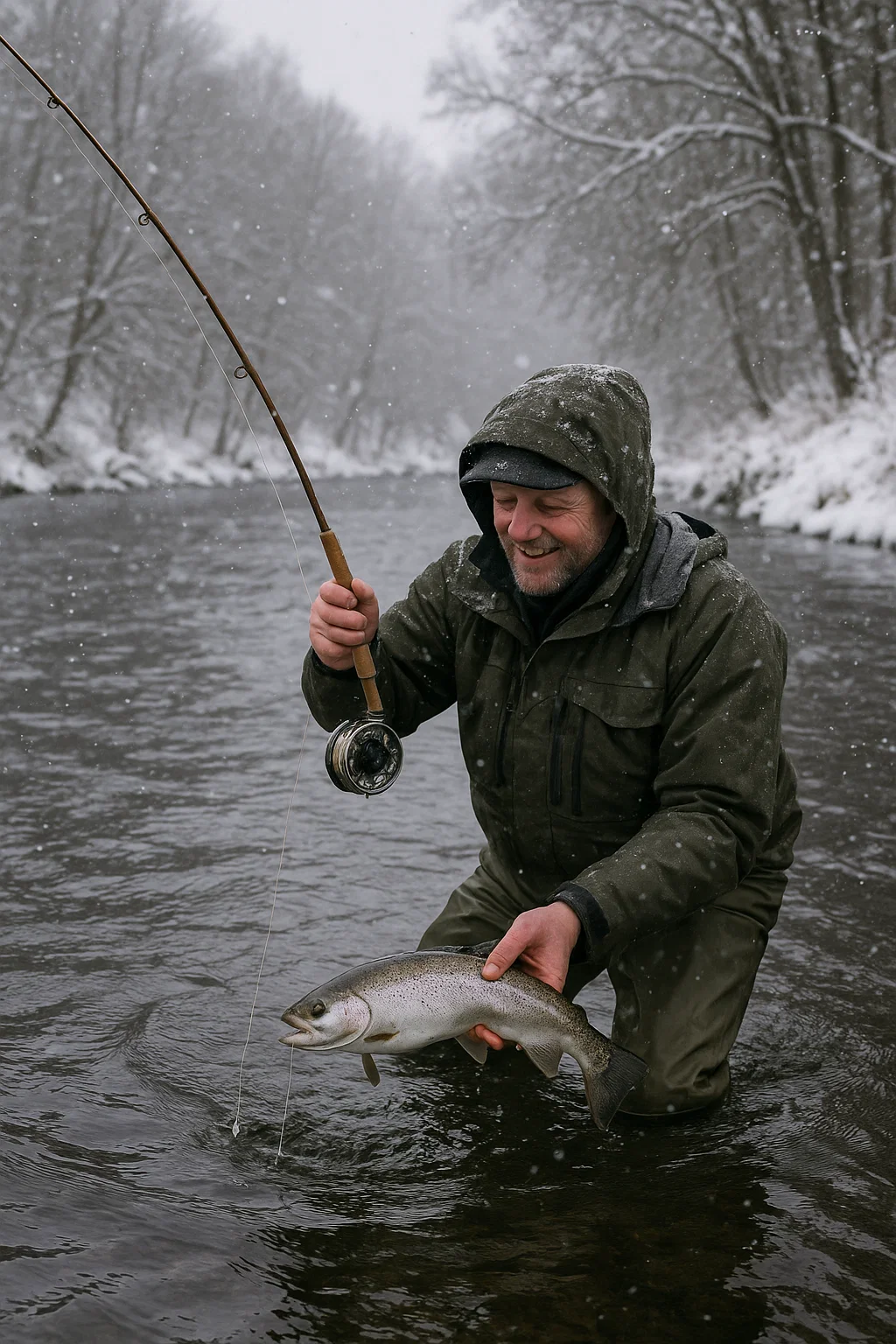
1. Check Access, Byelaws and Conditions First
Before travelling, check the relevant season, fishery rules, access arrangements and Environment Agency or local byelaws. Trout and grayling rules vary by catchment and water, and permission is always required.
Review the weather forecast, river level, recent rainfall and available daylight. Do not wade when the depth, pace, visibility or riverbed makes it unsafe. Fishing from the bank, changing venue or postponing the trip is better than forcing a plan in unsuitable conditions.
2. Dress in Layers and Protect Your Extremities
Warm, dry clothing helps concentration and dexterity. Use a moisture-managing base layer, an insulating mid-layer and a weather-resistant outer layer suited to the forecast. Avoid so much bulk that it restricts casting or safe movement.
Hands and feet often become uncomfortable first. Our guides to winter base layers, winter fly-fishing gloves and socks and boots explain the features to consider. Carry a dry spare layer and stop if cold begins to affect judgement or coordination.
3. Slow Down and Observe the Drift
Fish may be less willing to move far for food in cold water, although activity varies with species, temperature, flow and available insects. Begin with controlled presentations and watch how the current affects the line, leader and fly.
A natural drift is usually more useful than simply making the retrieve as slow as possible. Mend or reposition the line when needed, and change one variable at a time so you can tell whether depth, speed or location made the difference.
4. Adjust Depth Gradually
Trout and grayling often use deeper or steadier water in winter, but they are not always pinned to the riverbed. Start at a sensible depth for the pool or glide, then make gradual changes to weight, leader length or casting angle.
The aim is to keep the flies in useful water without repeatedly snagging or disturbing the lie. If the riverbed changes through the drift, one setting may not suit the whole run. Our winter grayling guide covers depth and drift control in more detail.
5. Look for Manageable Current and Nearby Depth
In cold or strong flows, fish may favour places where they can hold position without using excessive energy. Explore softer edges, inside seams, pool tails, deeper glides and slower water beside the main current. The best feature depends on river height, clarity and the shape of the channel.
Approach quietly and cover the nearest suitable water before casting across the whole river. The principles in our guide to reading a river for trout and grayling can help you identify seams, shelter and feeding lanes.
6. Carry a Small Range of Useful Flies
A compact selection in several sizes and weights is usually more useful than a crowded box of near-duplicates. Pheasant-tail and hare’s-ear-style nymphs, small dark patterns, shrimps and a few heavier flies can cover many situations, but local insects and fishery rules should guide the final choice.
Change size, weight and profile in response to the water rather than assuming one pattern is universally best. See our winter fly-pattern guide for a practical starting selection.
7. Choose Tippet for the Method and Water
Fluorocarbon can be useful for subsurface fishing because it is relatively dense and abrasion resistant, but it is not invisible and it is not automatically the right choice. Nylon may be preferable for some presentations, particularly near the surface.
Select diameter and breaking strain according to the fish, flies, snags and water clarity rather than relying on a fixed size. Check for damage regularly, use the strongest practical material for the situation and take all discarded line home.
8. Watch for Subtle Changes
A winter take may show as a pause, hesitation, sideways movement or unexpected tightening rather than a sharp pull. Keep enough contact to detect change without dragging the flies unnaturally.
Use an indicator, sighter or direct-contact method that suits the water and your technique. Smaller indicators can reduce resistance in some situations, while a larger or more visible option may be useful in broken water. Lift smoothly when a change suggests a take; repeated aggressive strikes can disturb the area.
9. Treat Timing as Variable
There is no dependable daily feeding window that applies to every winter river. A mild midday period may bring more activity on one water, while flow, cloud, hatches or fishery pressure may matter more elsewhere.
Use local knowledge and direct observation rather than relying on a fixed 11am-to-3pm rule. Plan around legal fishing times, safe access and daylight, and leave enough time to pack up and return safely before conditions deteriorate.
10. Move Methodically, Not Automatically
Winter fish can gather in limited areas, so covering more than one suitable feature may help. Before moving, alter depth or presentation and make sure you have covered the water carefully. Ten minutes without a take is not proof that no fish are present.
Move only when the bank and river conditions allow it. Avoid unnecessary wading, give other anglers room and do not repeatedly disturb a productive or sensitive area. A careful change of position is more useful than rushing from pool to pool.
Final Thoughts
Good winter fly fishing depends on observation and measured adjustments rather than fixed formulas. Check the rules and conditions, stay warm, manage depth carefully and respond to what the river shows you. A shorter, safe and well-considered session is more valuable than persisting when the conditions are unsuitable.